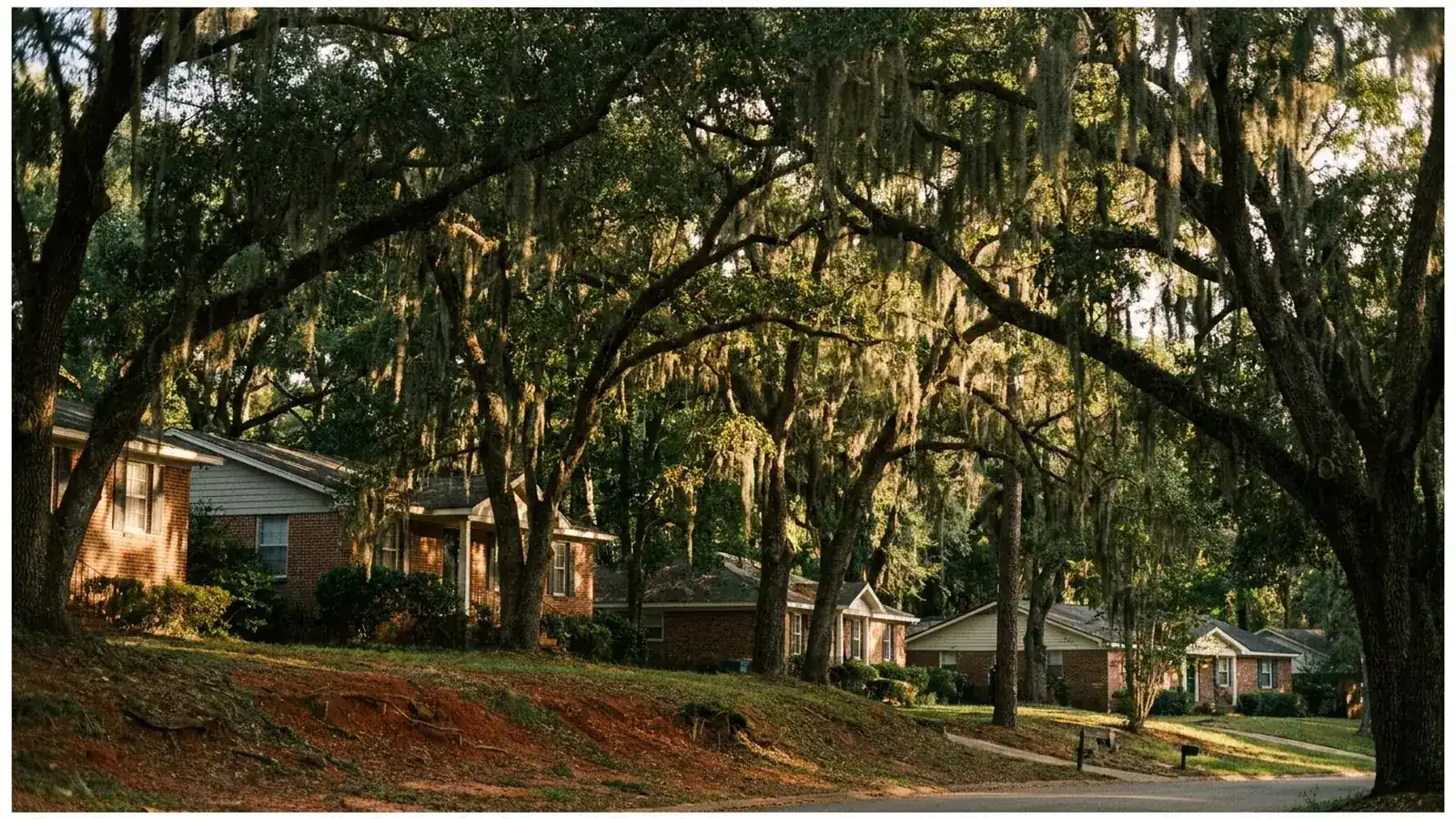
Mold coverage in Tallahassee turns on what let the water in. Policies respond to sudden and accidental events and exclude gradual deterioration, and in this canopy city the sudden event is most often a tree, which opens the building and lets the water follow.
Why the canopy is the local variable, what the assessor split means for your paperwork, and what to document.
The canopy is the local variable
The tree cover that makes this city what it is also makes it a storm liability. Hurricane Hermine in 2016 and Hurricane Michael in 2018 both brought significant tree damage to the region, and a tree through a roof is exactly the kind of sudden, accidental event a policy is written to respond to.
What follows is water, and then growth, and the growth is generally assessed as part of the original event rather than separately. Storm-driven growth is a different starting point from the slow kind, and the date of the storm is the anchor for everything.
One Florida wrinkle worth knowing before you file
Florida licenses mold assessors and remediators separately, and under Fla. Stat. 468.8419 neither may perform the other's work on the same structure within twelve months. If your insurer asks for an independent assessment, that has to come from a licensed assessor rather than from us — we remediate. It is worth knowing before you are asked for a document we are not permitted to write.
How do I work out when it started?
This is the question that decides a claim, and most people cannot answer it straight away. The useful evidence is rarely the growth itself — it is the things you noticed and dismissed. A smell that arrived and then became normal. A ceiling stain you have stopped seeing. A door that started sticking one season. Cupping floorboards in one room. A utility bill that stepped up and never came back down.
Write down what you noticed and roughly when, before anyone opens anything. Where the damage is urgent enough that you cannot wait — water actively running, a ceiling sagging, a room you have stopped using — photograph it first and then deal with it. An emergency does not stop being an emergency because a claim exists, and no insurer expects you to leave water running.
Sudden or gradual: which side is my damage on?
Homeowner policies are written to respond to sudden and accidental events and to exclude gradual deterioration. Mould is almost never the thing being assessed — the water that caused it is. So the question an adjuster is really answering is what let the water in, and whether that happened in a moment or over months.
A pipe that bursts is an event. A roof opened by a storm is an event. A seal that has been weeping for two years, or a house that has run humid all summer, is not — however dramatic the growth that follows.
What should I document, whatever the answer turns out to be?
- The date, as precisely as you can establish it. Sudden claims live or die on it.
- Photographs before anything is disturbed, including the source if it is visible.
- Any repair history — who worked on it, when, and what they said.
- A written scope naming the moisture source, not just the growth. That is the document an adjuster can act on.
We are not an insurer or a loss adjuster and we do not advise on coverage. What we can give you is the technical half: what we found, where the water came from, and when the evidence suggests it started. Read your own policy's exclusions, because they differ between insurers and between states.
Claims, answered plainly
Will insurance cover mold after storm damage?
Where a storm opened the building, the water and what follows are normally assessed as part of that event. The date is the anchor, so establish it as precisely as you can.
A tree hit the house months ago. Is it too late?
That is a question for your insurer rather than for us. What we would say is that the evidence gets harder to read once repairs go over it, so documenting the current condition is worth doing now either way.
Can you write the assessment my insurer wants?
We can't write the assessment your insurer wants. Florida licenses assessors and remediators separately, and Fla. Stat. 468.8419 bars either from doing the other's work on the same structure. An independent assessment has to come from a licensed assessor.
What do you provide?
The remediation record: moisture readings, photographs, and a written scope naming the water source. That is the technical half, and it is what an adjuster can act on.
When does a policy pay for mold work?
Tallahassee's tree canopy writes a lot of these claims: a limb through the roof is a covered peril, and the mold that follows it is the arguable part.
| Situation | What it means | The local wrinkle |
|---|---|---|
| Humidity or deferred maintenance | Excluded nearly everywhere — the gradual kind | Canopy-shade dampness growing on a sound house is the excluded, gradual kind |
| After a sudden burst pipe | The resulting mold is often covered, subject to caps | The limb-through-roof sequence — Hermine and Michael wrote the local template |
| After rising flood water | A flood-policy question, not a homeowner's-policy one | Storm rain through opened roofs is homeowner's territory; rising water is flood's |
| Any covered scenario | Mold riders cap payouts low — read the limit before scoping | Florida's statutory split gives you an independent assessor — adjusters credit that |
The statute helps here more than people realise: an assessment from someone barred from selling you the remediation is exactly the evidence a disputed claim wants.
Get a free Tallahassee remediation quote
If you already hold an assessor’s protocol, say so — we quote directly against it. If you do not, describe what you have found and roughly how large an area it covers. Ten square feet is the line Florida draws, and knowing which side of it you are on changes what you need next. Same working day reply.